Care about Your Mother
Scobies (also called “the mother”) are treasures for brewmasters and homebrewers alike. They’re the masterminds behind the fermentation process for many goods, including kombucha. Given tea and sugar as fuel, the scoby and its starter liquid ferments the tea, developing strands of probiotic yeast that give kombucha its carbonated, tangy, and probiotic profile.
A brewer just finished a batch of kombucha and isn’t sure what to do with their used scoby, now what? Does it get tossed out? Stored in the fridge? Eaten? While few brewers do all three, scoby can be up-cycled or reused in a number of ways, or even stored in a scoby hotel for later use. Let’s go over proper scoby care.
The Cycle of the Scoby Culture
To understand how to go about scoby care, it’s important to know what even a scoby is. It’s a symbiotic culture of bacteria and yeast; simple enough right? What does that have to do with care and use of it? A scoby is a living and breathing organism made up of billions of microorganisms (acetobactor (acetic acid) being one such bacteria out of dozens). So naturally, it needs to breathe and be fed, kind of like a pet; at least I (Brewmaster Ryan) think so, I even give mine names!
We’ll discuss proper feeding routines in a bit, but first it helps to understand that scobies grow over time if conditions are ideal, aka. – kept in a fermentation vessel with adequate tea, sugar, and liquid at around 75°F. After 4-7 days, a pellicle forms over the top of the scoby, a protective barrier between the liquid and the air above, and this pellicle becomes part of the scoby. This is because the bacteria in the culture feed on the sugar, growing and releasing ethanol and carbon dioxide.
After several days, the scoby may appear thick. If you plan to start a new batch of kombucha, it may be smart to trim the scoby so it appears between 1 cm and 1 inch thick using clean hands and sterile scissors or tongs (be sure not to clean with antimicrobial soap). There’s a number of uses for the extra scoby, one such use being used in an extra brew vessel. And so, the process of scoby growth repeats. Looking to start a first fermentation and not sure how to get started? Check out our guide here!
Proper Scoby Temperature
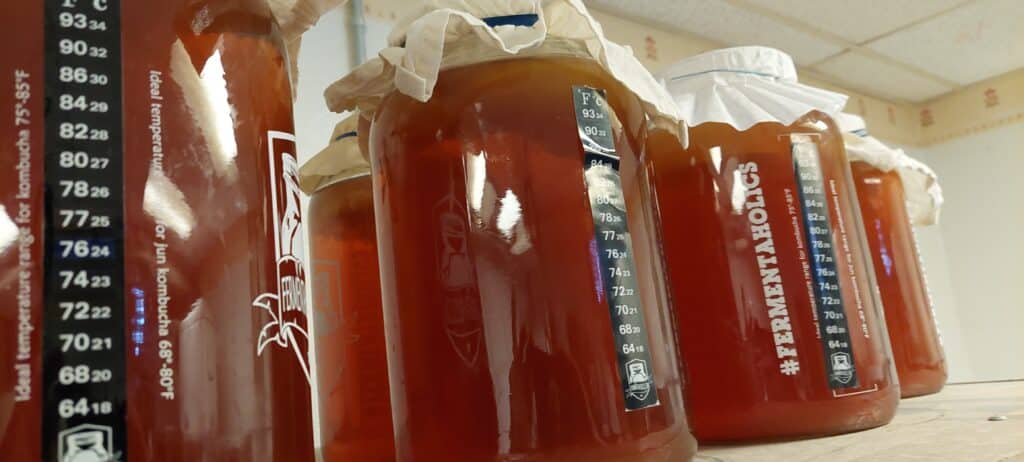
Scobys quite literally have a life of their own. They’re sensitive to temperature (like certain animals, think reptiles) so ideally they need to be stored at or above 70°F and below 86°F, 75-80°F for best results. Below 65°F, the scoby may go dormant, and definitely cannot be kept in the fridge. Trying to reawaken it through a new brew can be attempted but may not succeed and could result in mold growth. This happened to us, and we had to start fresh with a new scoby and tea. Certainly do not keep moldy scobys or it’s booch!
At the same time, the scoby shouldn’t be kept above the 86°F threshold because it can and it will die from the heat. So proper temperature all the time is extremely important for proper scoby care. I use a heat wrap on my personal brew vessel specifically for kombucha; a seeded heat mat works as well. They’re not too expensive ($10-30 typically), and they let you brew year round without difficulty, and I call that ‘winning at life’.
Scoby Hotel 101
Ever heard of a ‘scoby hotel’? It’s a must-know for anyone wanting to practice proper scoby care. It’s essentially a brew vessel (typically a gallon or more) used to store and hold scobies. A brewer may find that they want to take a break from brewing, or have extra scobies, so they may decide to store it in one of these scoby hotels until they’re ready to brew again. I myself have had to make scoby hotels for different circumstances such as being away from home for several days or simply not having enough time to brew. Life happens to all of us. Let’s go over the basics of the scoby hotel.
How does a brewer go about feeding and storing their scobys for extended periods of time? Simply put, they make a batch of kombucha with it. Unflavored black, green, white, pureh, or oolong teas are great for providing nutrients. Granulated sugar is ideal and used for fuel. Leaving the brew vessel covered with a breathable cloth or coffee filter allows clean air to enter. More of this information can be found in our other guide to F1 linked above.
Set it and forget it… alright maybe don’t forget your booch. It’s important to regularly monitor your brew vessel for formation of bacterial yeast, a thin pale layer of the called a ‘pellicle’ forming over the top of the scoby, and any mold (often fuzzy green or white in color). That last one is a definite sign to stop and redo the entire process with a fresh scoby and starter tea. You may notice strands of dark yeast floating which is a sign of good health, and you should definitely notice your scoby gradually getting thicker as the weeks pass.
Scoby Time Lapse
As your scoby sits in your 1+ gallon kombucha brew vessel, it will double, triple, quadruple, quintuple, and so forth as the days turn to weeks and weeks turn to months. There’s reports of brewers even leaving their scoby untouched for longer than a year. The importance in this part of scoby care is to monitor and be sure the scoby appears a healthy pale color and no signs of mold.
Over time, the kombucha will also become quite acidic, which makes for wonderful starter liquid for a new batch, the acidity giving better protection for the scoby from any harmful bacteria in the sweet tea during F1. However, kombucha should never be consumed straight out of the scoby hotel, as the level of acidity is too much for human consumption. We’re talking about a pH lower than apple cider vinegar, which sits around a pH of 2, very acidic.
Another change over time is that the kombucha will evaporate and be consumed by the scoby, so if the liquid is drying up, it’s a good idea to make a small batch of sweet tea. Try scoby “feed”:
1 tsp black tea or 1-2 tea bags
2 cups water
2 tbsp cane sugar
Make the sweet tea and strain the tea leaves/bag out. Let it cool off to room temperature, and add to your scoby hotel. Another option is to just feed your hotel kombucha from a finished F1 batch.
Upcycle Your Scoby
Let’s move away from scoby care briefly and talk about my favorite topic, upcycling. What does it mean to upcycle? It’s all about finding new uses for everyday things. While it’s important to recycle the things we can’t reuse, it’s a great idea to make new use of the things that can still be used! What does this mean? A simple example is a plastic water bottle; when empty, try cutting it in half with scissors and adding soil to the bottom half to make a makeshift pot for plants. Another is the skin of plants like bananas, which can be added to compost as a natural fertilizer for plants.
We won’t go into detail here, as there’s enough to cover a whole other post. But brewers have found some amazing uses for scoby besides kombucha brewing, such as grinding up and adding to granola to make energy bites, or even dehydrating and making into a purse! Someone really did this. The sky is the limit, as tossing into the trash isn’t the only option for retired scobys. Please recycle; please reuse. We only have one Earth. But enough of the PSAs.
Wrap this Up
I realize I went all over the place in this post discussing proper scoby care, so let’s summarize what we just went over.
*Deep breath* – Scoby care isn’t complicated and involves simply monitoring the culture after making a batch of kombucha using tea, sugar, and filtered water and storing at temperatures around 75-85°F. The brew vessel can also be used as a scoby hotel. After 2 or more weeks of sitting in your hotel, the kombucha will become more acidic and the scoby will grow considerably in size.
Other scobies can be added to the hotel as well. If the liquid is drying up, make scoby feed using tea, sugar and water (sweet tea). Don’t drink kombucha from the scoby hotel, but please do use it as an excellent starter liquid for a new batch of kombucha. Storing in the hotel or discarding in the trash aren’t the only uses for scobies, and brewers have found awesome ways to upcycle them.
Did you catch all that? Good! Scoby care isn’t too difficult, and making a scoby hotel can save you time and energy spent elsewhere when needed. We hope you enjoyed reading this article as we enjoyed writing it!